
2017 World Judo Championships: A guide to 'the gentle way'
Updated 0936 GMT (1736 HKT) August 24, 2017

Photos: A guide to judo
"It is a sport that demands an irreproachable lifestyle," Riner tells CNN, "a sport that demands rigor."
Hide Caption
5 of 9

Photos: A guide to judo
On the women's side, Ryoko Tani's record stands out. The Japanese Judoka has seven world titles, and upon her retirement was hailed as the "best female judoka ever."
Hide Caption
6 of 9

Photos: A guide to judo
Majlinda Kelmendi tears up after being crowned Kosovo's first ever gold medalist at the Rio Olympics in the women's 52 kg weight category.
Hide Caption
7 of 9

Photos: A guide to judo
At 218 kilos, judoka Ricardo Blas Jr. (seen here on the right competing at London 2012) is the world's heaviest Olympian.
Hide Caption
8 of 9

Photos: A guide to judo
Russian President Vladimir Putin is a judo master, denoted by wearing a black belt.
Hide Caption
9 of 9

Photos: A guide to judo
The first judo school dates back to 1882 in Tokyo. Traditionally a Japanese practice, it has gradually spread across the planet and established itself as one of the world's most popular combat sports.
Hide Caption
1 of 9

Photos: A guide to judo
Literally meaning "gentle way," judo techniques harness an opponent's force to your own advantage by throwing and pinning them to the ground.
Hide Caption
2 of 9

Photos: A guide to judo
Judo was first seen at the Olympics in Tokyo in 1964, and a women's competition was added at the Barcelona Games in 1992.
Hide Caption
3 of 9

Photos: A guide to judo
No judoka has more world championships titles than Teddy Riner. The Frenchman has won eight gold medals, predominantly in the heavyweight category, and will be hoping to add to his tally having secured gold at the Rio Olympics last year.
Hide Caption
4 of 9
Photos: A guide to judo
"It is a sport that demands an irreproachable lifestyle," Riner tells CNN, "a sport that demands rigor."
Hide Caption
5 of 9
Photos: A guide to judo
On the women's side, Ryoko Tani's record stands out. The Japanese Judoka has seven world titles, and upon her retirement was hailed as the "best female judoka ever."
Hide Caption
6 of 9
Photos: A guide to judo
Majlinda Kelmendi tears up after being crowned Kosovo's first ever gold medalist at the Rio Olympics in the women's 52 kg weight category.
Hide Caption
7 of 9
Photos: A guide to judo
At 218 kilos, judoka Ricardo Blas Jr. (seen here on the right competing at London 2012) is the world's heaviest Olympian.
Hide Caption
8 of 9
Photos: A guide to judo
Russian President Vladimir Putin is a judo master, denoted by wearing a black belt.
Hide Caption
9 of 9
Photos: A guide to judo
The first judo school dates back to 1882 in Tokyo. Traditionally a Japanese practice, it has gradually spread across the planet and established itself as one of the world's most popular combat sports.
Hide Caption
1 of 9
Photos: A guide to judo
Literally meaning "gentle way," judo techniques harness an opponent's force to your own advantage by throwing and pinning them to the ground.
Hide Caption
2 of 9
Photos: A guide to judo
Judo was first seen at the Olympics in Tokyo in 1964, and a women's competition was added at the Barcelona Games in 1992.
Hide Caption
3 of 9
Photos: A guide to judo
No judoka has more world championships titles than Teddy Riner. The Frenchman has won eight gold medals, predominantly in the heavyweight category, and will be hoping to add to his tally having secured gold at the Rio Olympics last year.
Hide Caption
4 of 9
Photos: A guide to judo
"It is a sport that demands an irreproachable lifestyle," Riner tells CNN, "a sport that demands rigor."
Hide Caption
5 of 9


Story highlights
- World Judo Championships start August 28
- Judo was founded in Japan in 1882
- Judokas use force of opponent to win bouts
(CNN)It is one of the most popular sports in the world, practiced by 28 million people in more than 200 countries.
This month, Budapest is hosting the 2017 World Judo Championships where nearly 800 judokas will be hoping to pin down a gold medal and enter the sport's pantheon of greats.
With the competition kicking off on August 28, we take a look at Judo's rules, history, its guiding principles, and some of the stars to watch at this year's showpiece.
'The gentle way'
Judo was founded back in Japan in 1882 by Kanō Jigorō who envisaged not just a martial art (bujutsu) but a way of life.
The Japanese word means "gentle way" in English and its defining technical principle is to use the strength of an opponent against them.
In a competitive setting, judoka aim to throw, pin or force their rival into a submission which is signaled by saying the word "maitta," or by tapping the mat or the opponent at least twice.
Key Terms
Judoka - Practitioner of judo
Judogi - Judo uniform
Tatami - Judo mat
Sensei - Judo teacher
Holding techniques include applying pressure to an opponent's neck or manipulating the elbow joint, but thrusts and strikes -- common in martial arts like karate -- are only permitted in pre-arranged forms, or "kata," of the sport.
After taking to the mat, called the tatami, regulation bouts last four minutes for both males and females.
Competitors wear either blue or white, with the universal judo uniform known as the judogi. Seniority is based on a ranking system, denoted by the color of a judoka's belt, from white belt for beginners through to a variety of black belts.
Scoring
There are two different ways of scoring -- ippon and waza-ari

Maki Tsukada of Japan pins Dayma Beltran of Cuba for ippon during their gold medal match at the 2004 Athens Olympics.
Ippon: Judo's equivalent to a knockout, signaled by the referee with a straight arm raised above the head, an ippon immediately ends the match.
An ippon is awarded for a throw that places the opponent flat on their back with sufficient force and control; a pin that places the opponent on their back for 20 seconds; or a submission.
Waza-ari: A waza-ari is a lesser throw that places the opponent on their back, but without the force or control to merit the awarding of an ippon, or a pin that places the opponent on their back for more than 10 seconds.
The referee signals a waza-ari has been scored by extending their arm out at shoulder level with the palm of their hand facing downwards.

Colombia's Yuri Alvear (white) scores a waza-ari against China's Fei Chen at the London 2012 Olympic Games.
During a match, the referee may penalize a judoka for passivity, the use of prohibited techniques or behavior deemed against the spirit of judo.
Hansoku-make: This signifies an outright disqualification and can be invoked for any major breach of the rules. Minor breaches, such as stepping outside of the allotted mat area, are known as shido with three shido resulting in a hansoku-make.

Kayla Harrison of the US throws Guusje Steenhuis of the Netherlands for yuko at Tokyo Metropolitan Gymnasium.
Guiding principles
Seiryoku zen'yō: "Maximum efficiency, minimum effort"
The principle of seiryoku zen'yō, as defined by Kanō, aims to show that more powerful opponents can be overcome by superior technique.
When your opponent pulls, you push; when he pushes, you pull.
Jita kyōei: "Mutual welfare and benefit"
Accoring to French star Teddy Riner, judo "is a sport which demands an irreproachable lifestyle, a sport which demands a rigor. (There is) a moral code which is similar to that which you learn from your parents."
Judo's key dates

Japanese wrestler Isao Inokuma beats Canada's Alfred Douglas Rogers in the Judo Heavyweight final at the Tokyo Olympics, 1964.
- 1882 Judo's creator, Kanō, opens a dojo at the Eisho-ji temple in Tokyo. It is later known as the Kōdōkan, meaning "the place for expounding the way."
- 1932 Judo is included as a demonstration sport in the Games of the 10th Olympiad in Los Angeles. Kanō is initially reticent when asked if he thinks it should be included as a sport.
- 1951 International Judo Federation (IJF), responsible for organizing and hosting competitions, is founded.
- 1964 Judo becomes Olympic sport for men at 1964 Games in Tokyo. Dutchman Anton Geesink wins the first ever gold, beating Akio Kaminaga of Japan.
- 1992 A Women's Olympic division is introduced at the 1992 Games in Barcelona
Stars to watch
Teddy Riner

Eight-time world champion Teddy Riner is undefeated for seven years, but he hasn't seen competitive action since he retained his Olympic crown in the 100kg+ division at Rio 2016.
Lukas Krpalek

Lukas Krpalek of the Czech Republic could be the man to challenge Riner for his crown. Having won everything available to him in the -- 100kg category, he's now moved up a weight division, meaning we could see the last two Olympic champions go head-to-head.
Majlinda Kelmendi
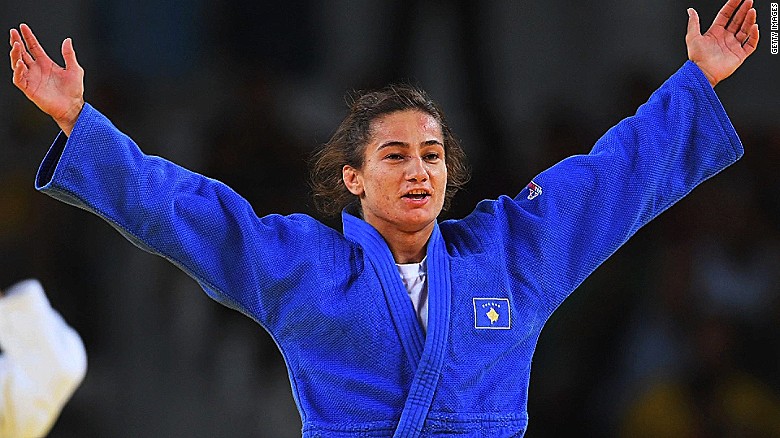
Majlinda Kelmendi won Kosovo's first ever Olympic medal when she took gold at Rio 2016.
World champion, Olympic flagbearer and Kosovo icon. Having previously represented Albania, Majlinda Kelmendi entered the history books in Rio, becoming Kosovo's first ever Olympic medalist.
Popole Misenga

Having grown up amid the five-year civil war in the Democratic Republic of Congo, judoka Popole Misenga sought asylum — without a passport, money or food — in Brazil after the 2013 World Championships in Rio.
Three years later, he competed at the Olympics in the same city.
Update: Yuko was removed from a 2017 update to the judo refereeing rules
No comments:
Post a Comment
add